
Two self-regulating heat-trace quotations are truly comparable only when they use the same design conditions, define the proposed cable in the same way, include the same system boundary and provide equivalent documentation. Comparing only watts per metre and unit price can hide differences in reference temperature, exposure limits, circuit length, jacket construction, accessories, certification scope and buyer responsibilities.
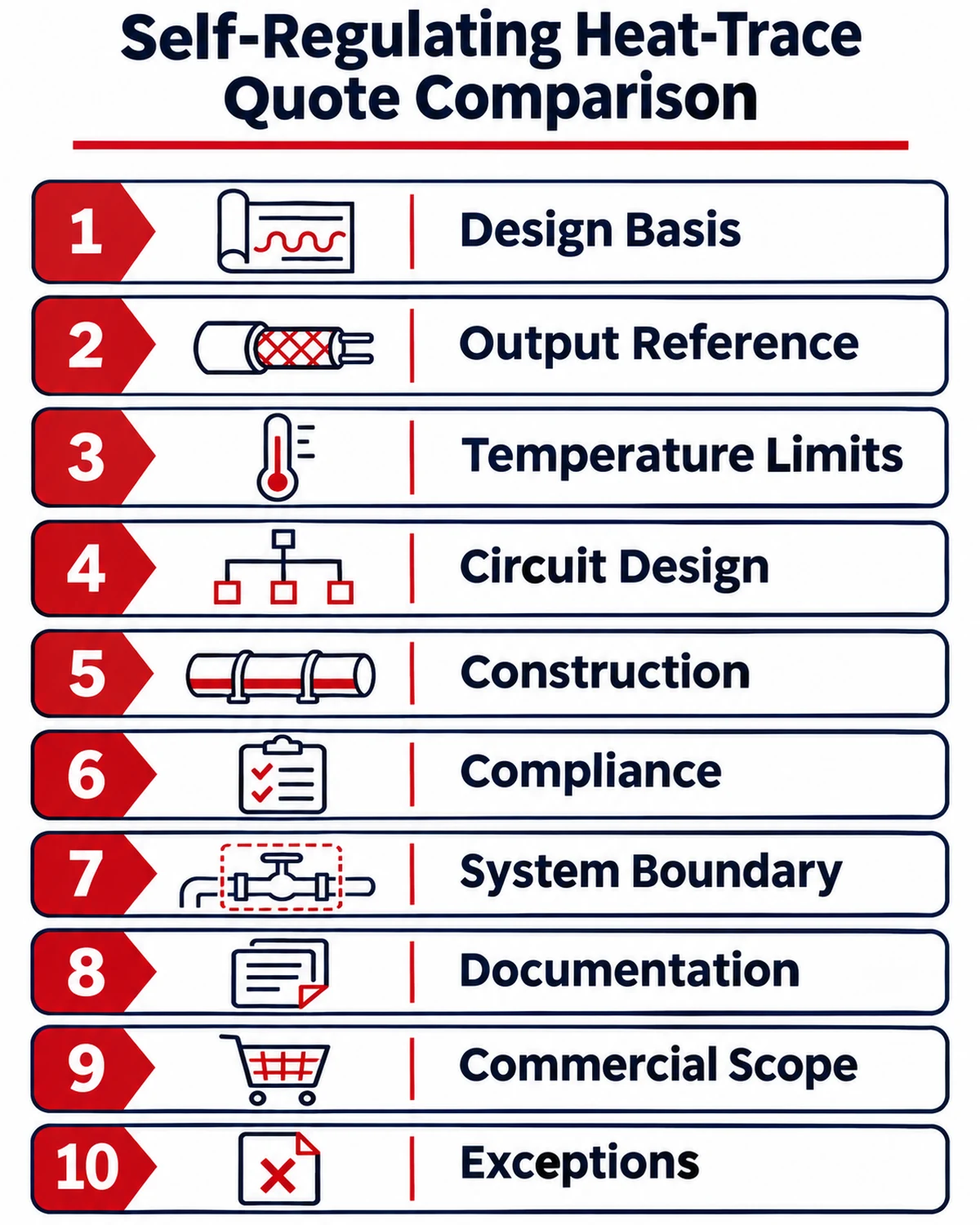
A sound technical-commercial comparison should cover ten areas:
- Design basis
- Power-output reference conditions
- Maintain and exposure temperatures
- Voltage, cold-start and circuit protection
- Cable construction and environmental suitability
- Area classification and market compliance
- System components and accessories
- Engineering and quality documentation
- Commercial terms and lifecycle support
- Assumptions, exclusions and change conditions
The objective is not to select the quotation with the most pages. It is to identify which supplier has defined the duty, product and delivery boundary clearly enough for procurement to make a defensible decision.
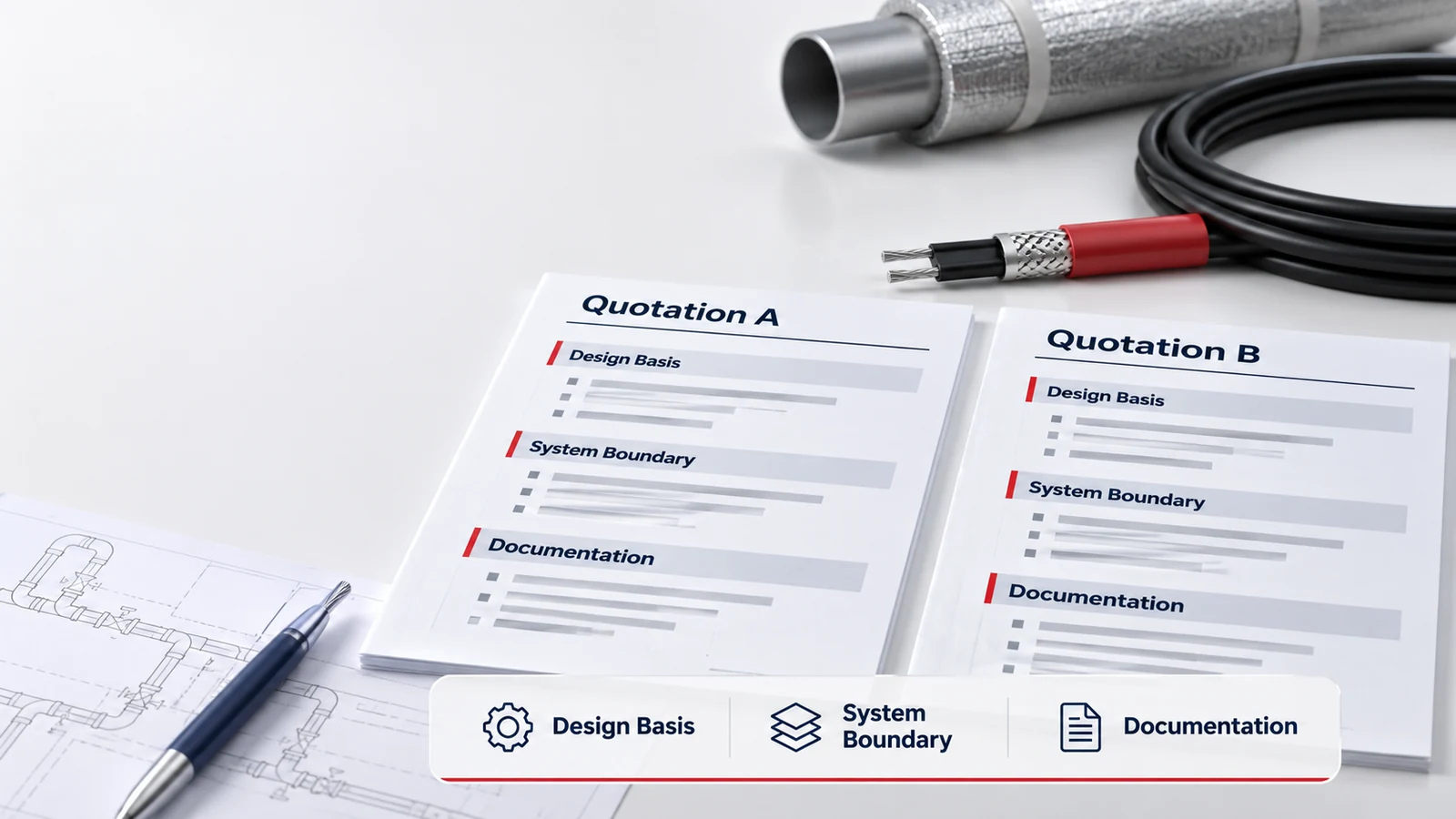
Technical-commercial comparison matrix
| Comparison area | Questions procurement should ask | Evidence expected |
|---|---|---|
| Design basis | Are application, pipe size and material, insulation, maintain temperature, minimum ambient, start-up temperature and heated length identical? | Completed line list, calculation basis or quotation assumptions |
| Output | At what cable temperature, voltage and installation condition is W/m or W/ft stated? | Product data curve or controlled data sheet |
| Temperature limits | Are maintain, continuous exposure and intermittent or power-off exposure clearly separated? | Exact model data sheet with definitions |
| Circuit design | What voltage, breaker type, start-up condition and maximum circuit length were used? | Circuit schedule or design table for the quoted model |
| Construction | What are the conductor, heating core, insulation, braid and outer-jacket constructions? | Model-specific construction and environmental suitability data |
| Compliance | Does the exact model and configuration meet the destination-market and area requirements? | Valid model-level certificate, listing or declaration where required |
| System boundary | Are connections, terminations, junction boxes, tees, sensors, controllers, fixing and labels included? | Itemised bill of materials and exclusions |
| Documentation | Are calculations, drawings, manuals, test records and traceability documents included? | Document register and submission schedule |
| Commercial scope | Are quantity, MOQ, lead time, packaging, Incoterm, warranty and support stated on the same basis? | Commercial schedule with defined responsibilities |
| Exceptions | What information is assumed, excluded or subject to change? | Deviation list and clarification record |
1. Normalise the design basis first
Before comparing prices, place both quotations against one approved input sheet. Confirm that the suppliers used the same application, pipe diameter and material, insulation type and thickness, maintain temperature, minimum ambient temperature, energisation temperature, voltage, heated length and allowance for valves, flanges and supports.
If one supplier assumes thicker insulation or a warmer ambient condition, its required output may appear lower. If another includes fittings and construction allowance, its cable quantity may appear higher. Neither difference can be judged fairly until the assumptions are aligned.
Use the preceding LONRIHEAT guide, Heat-tracing quotation checklist, to establish a common RFQ basis before scoring supplier responses.
2. Compare output at the same reference condition
Nominal output is not a stand-alone property. For self-regulating cable, output changes with the temperature of the surface being heated. A quotation stating “30 W/m” is incomplete unless it also identifies the reference temperature, supply voltage and relevant installation basis.
Ask each supplier for the output curve or controlled data for the exact proposed model. Do not compare one cable at 10°C with another at 0°C, or one at nominal voltage with another under different electrical conditions. Procurement should record the common comparison point rather than copying the largest number into a scorecard.
3. Keep temperature definitions separate
Maximum maintain temperature, maximum continuous exposure and maximum intermittent or power-off exposure are different limits. Suppliers may use different terminology, so the evaluation should reproduce the definition from each controlled product document.
This is particularly important where the process can become hotter than the normal maintain setpoint, or where steam cleaning, hot flushing or shutdown heat exposure may occur. A cable can be adequate for normal operation but unsuitable for exceptional exposure.
4. Review cold-start and circuit protection together
Self-regulating heat trace can draw more current when energised at low temperature. Therefore, allowed circuit length cannot be compared independently of start-up temperature, voltage, breaker rating and breaker characteristic. Ground-fault or residual-current protection and local code requirements may also affect the design.
Request the exact circuit-design basis for the quoted model. A generic “maximum circuit length” taken from another series, voltage or start-up condition is not equivalent evidence. If a supplier has not stated the cold-start assumption, mark the circuit length as unverified rather than accepting it as a firm design value.
5. Compare construction against the environment
The evaluation should identify the cable construction, including the conductive heating core, primary insulation, metallic braid or grounding path, and outer jacket. Then compare that construction with the actual environment: indoor or outdoor, wet, UV-exposed, corrosive, mechanically exposed or subject to washdown.
A lower-priced cable without the required outer-jacket or chemical resistance is not an equivalent offer. Conversely, a higher-specification jacket may add cost without adding value if the application does not require it. Procurement should score suitability, not adjectives such as “premium” or “industrial grade.”
6. Verify compliance at exact-model level
Brand-level certification claims are insufficient. Ask whether the exact cable model, voltage, jacket, temperature class, connection components and intended application fall within the claimed approval or declaration.
For hazardous areas, provide the required classification system, zone or division, gas or dust group and temperature class. For ordinary locations, still confirm the applicable market and project requirements. If the certificate scope or listing cannot be matched to the quotation, record the item as pending rather than assuming equivalence.
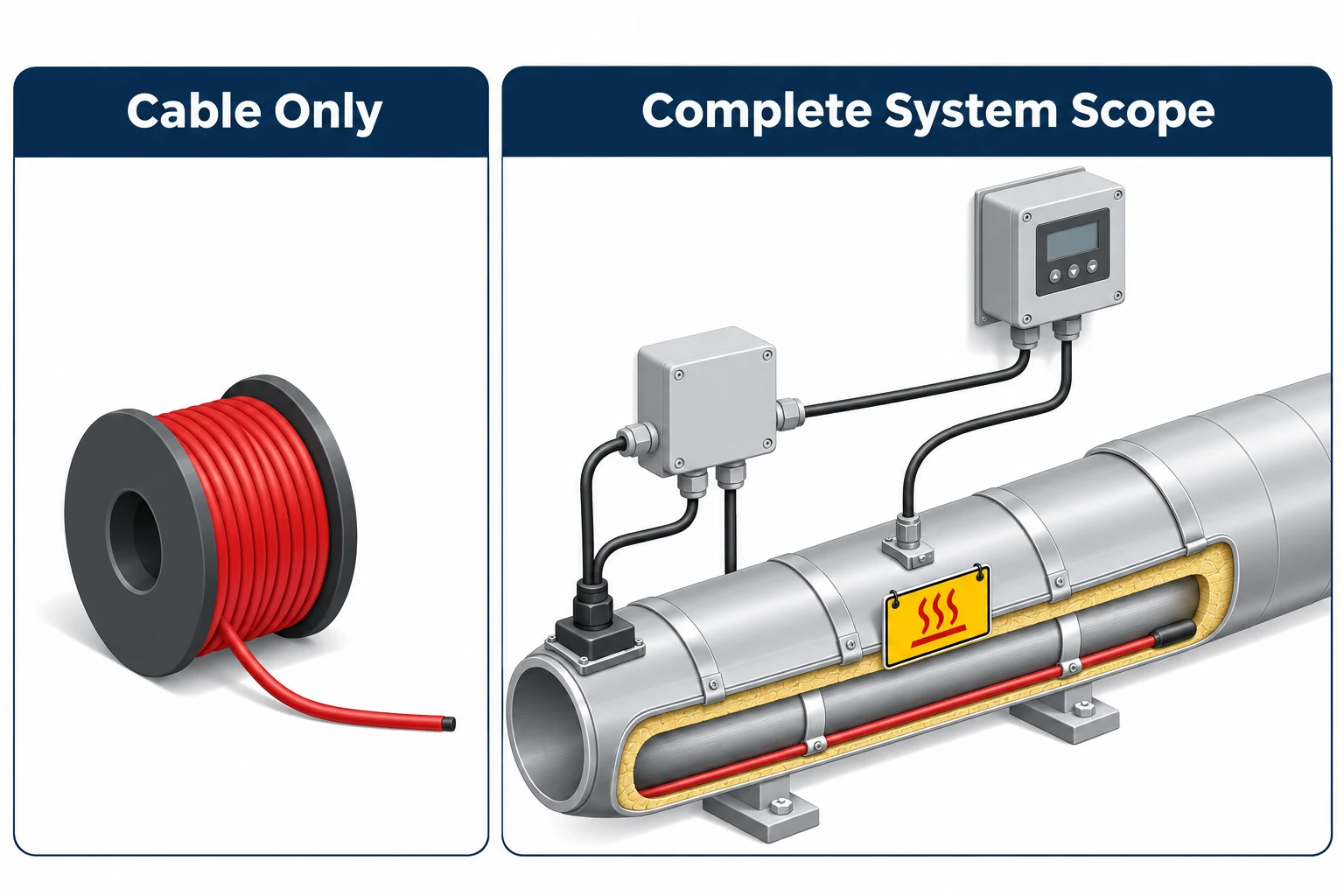
7. Compare the complete system, not cable-only pricing
One quotation may include only heating cable. Another may include power connections, end terminations, tees, junction boxes, glands, fixing materials, sensors, controllers, warning labels, spare parts and commissioning documentation.
Create a component-by-component reconciliation table. Mark each item as included, excluded, optional or supplied by the buyer. This prevents a low cable price from winning the comparison while shifting essential costs to installation or a later purchase.
Relevant LONRIHEAT product-family pages include self-regulating heating cable and controls and accessories. Final compatibility, ratings and certification must still be confirmed in controlled model documents and the approved quotation.
8. Score the document package
For engineering procurement, documents are part of the deliverable. Depending on the project, the buyer may need a data sheet, heat-loss or selection basis, circuit schedule, bill of materials, drawings, installation manual, inspection record, certificate, declaration, packing list and traceability information.
Ask for a document register showing what will be submitted at quotation, approval, production and shipment stages. A vague promise to “provide documents later” should not receive the same score as a defined, model-linked submission plan.
9. Align commercial terms
After technical normalisation, compare commercial conditions on the same basis: currency, quantity, MOQ, packing unit, Incoterm, destination, lead time, sample or trial-order terms, warranty boundary, spare parts and after-sales response.
For OEM or private-label supply, add sample approval, label and packaging control, instruction language, change notification and batch traceability. A lower unit price may not be lower overall if it excludes packaging, testing, documentation or accessory assembly required by the buyer.
10. Make assumptions and deviations visible
Every quotation contains assumptions. The risk comes when they remain hidden. Require suppliers to list missing inputs, deviations from the RFQ, buyer-supplied items, exclusions and conditions that can change price or technical selection.
A useful evaluation ends with three lists:
- confirmed equivalent items;
- differences that affect price or performance;
- open questions that must be resolved before award.
Red flags in a self-regulating heat-trace quotation
Procurement should pause the evaluation when a quotation:
- states W/m or W/ft without a reference temperature and voltage;
- uses “maximum temperature” without defining maintain or exposure conditions;
- gives a circuit length without start-up temperature and breaker basis;
- omits the exact cable model or jacket construction;
- claims certification without a matching model and application scope;
- prices cable but does not identify connections, terminations and controls;
- presents competitor or generic data as evidence for the proposed product;
- promises engineering documents without a document list;
- omits buyer responsibilities, exclusions or validity conditions;
- claims complete equivalence without a line-by-line deviation review.
A practical scoring method
Use a gate before applying weighted scores. First confirm that each offer is technically eligible for the application and market. An offer that fails a mandatory temperature, environmental or compliance requirement should not win through a lower price score.
For eligible offers, a project team can weight categories according to risk—for example, design basis, technical suitability, system completeness, documentation, commercial terms and support. Record the evidence behind every score. Do not create false precision by assigning numbers to unresolved items; mark them “pending clarification.”
LONRIHEAT’s procurement perspective
LONRIHEAT is the export brand of Wuhu Huaheng Electric Heating Technology Co., Ltd., a China-based electric-heating manufacturer founded in 2015. The supplied company foundation states that its founder has worked continuously in the electric-heating industry since 2005.
That documented experience supports a practical editorial principle: the lowest cable price is not necessarily the lowest system cost when the design basis, accessories, documents and compliance boundary are different. This is a synthesis of the company’s recorded industry approach, not a verbatim founder quotation.
LONRIHEAT can discuss product-family selection, accessory matching, samples or trial orders, and selected OEM/ODM requirements from a completed application data sheet. Exact models, ratings, certifications, circuit limits, commercial terms and delivery commitments must be confirmed in the approved quotation and controlled technical documents.
Frequently asked questions
Can two 30 W/m self-regulating cables be considered equivalent?
Not automatically. Confirm the reference temperature, voltage, output curve, maintain and exposure limits, jacket construction, circuit design, approvals and system components for each exact model.
Should procurement compare price per metre?
Price per metre is one commercial input, but it should be reviewed only after normalising the design basis and included scope. System cost may also include connections, terminations, controls, installation materials, documentation and testing.
What is the most important document to request?
There is no single universal document. At minimum, request the controlled data sheet for the exact model and an itemised quotation. Project work may also require calculations, drawings, circuit schedules, manuals, certificates and inspection records.
How should certification claims be compared?
Match each claim to the exact model, construction, voltage, market, application and accessory configuration. Do not treat a brand-level logo or unrelated certificate as proof for the quoted system.
What if suppliers used different assumptions?
Issue a clarification sheet with one approved design basis and ask both suppliers to revise or clearly state deviations. Do not force a price ranking until material differences are resolved.
Can LONRIHEAT review competing quotations?
LONRIHEAT can review a buyer’s application data and identify whether quotation fields appear to use different boundaries. Any third-party quotation should be appropriately redacted, and the review should not be treated as certification or independent engineering approval.
Compare on one documented basis
Before awarding a self-regulating heat-trace order, align the operating conditions, output reference, temperature definitions, circuit assumptions, construction, compliance, accessories, documents and commercial scope. A neutral comparison matrix makes differences visible and creates a clearer record for technical and procurement approval.
CTA: Submit a redacted quotation comparison together with the common application data sheet. LONRIHEAT can help identify missing or non-comparable fields and discuss an appropriate product-family and accessory scope. Final engineering, certification and commercial commitments remain subject to controlled model documents and an approved quotation.
Sources and attribution boundary
External sources support general evaluation dimensions only. Their product values, approvals, warranties and capabilities are not LONRIHEAT claims.
- Chemelex RAYCHEM, Selection Guide for Self-Regulating Heat Tracing Systems: https://pim.chemelex.com/Product%20Documents/Brochures/RAYCHEM-SB-EU0264-SelfRegulating-EN.pdf
- Chemelex RAYCHEM, Engineering Specification for Industrial Electrical Heat-Tracing Systems: https://pim.chemelex.com/Product%20Documents/Engineering%20Specifications/RAYCHEM-ES-H57428-IHS_HeatTraceSpec-EN.pdf
- Thermon, CommTrace Design Tool: https://thermon.com/resources_ext/Commtrace_Design_tool/
- eltherm, Self-Regulating Heating Cables: https://eltherm.com/en/products-and-systems/heating-cables/self-regulating-heating-cables/
- Chemelex RAYCHEM, QTVR Official Product Page: https://www.chemelex.com/en-il/raychem/products/qtvr-self-regulating-heating-cable
- LONRIHEAT Company Foundation File, internal supplied source, reviewed 2026-11-18.
Related products
 Self-Regulating Heating CablesSelf-regulating heating cable for pipe freeze protection and temperature maintenance. Compare low- and medium-temperature types, then submit your operating conditions for selection.
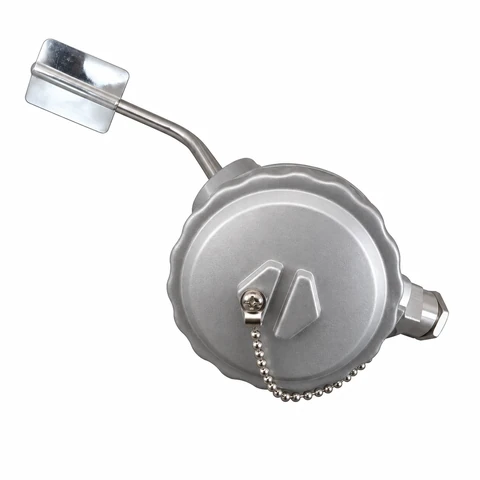 LONRIHEAT Controls and system componentsAn entry for controllers, sensors, connection components and installation accessories used with an approved heat-tracing design.
Related answers, products & documents
 What Information Should Buyers Provide for an Accurate Heat-Tracing Quotation?
 Engineering review
 Request a quotation
Continue from this guide
- LONRIHEAT Controls and system components
- Self-Regulating Heating Cables
- What Information Should Buyers Provide for an Accurate Heat-Tracing Quotation?
- Engineering review
- Request a quotation
- Industrial Pipe Freeze Protection
- Tank & Vessel Heating
- Fire Sprinkler Freeze Protection
- Commercial buildings
- Hot Water Temperature Maintenance
- Fire protection
Discuss the technical conditions · Request a quotation for your project